Sunday, November 19, 2017

Reflection

I responded directly to some of those questions:
  • How has this process been different from how you "normally" work? Or how you've worked in the past?

Usually my musical collaborations have been score-based and rehearsal-based; getting the notes right, portraying what’s on the score as accurately as possible, etc. — this collaboration was different for me in that it involved much more creative and social collaboration: concept building, narrative and world building, intuition and feeling exploration — I am used to generating these aspects of a project independently as a composer, so it was refreshing to collaborate with others in this way. It felt connected to social “play” and conversation. 

  • What will you take away from this way of working in your future work? 

Planning is overrated! Trying is better. My group discovered a bulk of what we did and did not want to include in our piece simply by trying — by playing, by practicing incorporating certain elements, by experimenting together — it seemed to be a much more effective way of figuring out what we wanted to and could include in the piece, what direction we wanted the piece to go in, etc. I think this approach is linked to intuition and feeling things freely in the moment. 

What kinds of compromises have you or others had to make for the sake of moving forward?

Since our piece had a lot of ideas (and still has lots of ideas), I think we took on an approach of throwing out lots of ideas and trying them but not getting too attached to them. An approach of only doing the things that feel right and contribute well to the piece, not trying to force things that we were initially excited about but might not work anymore. Maybe if we had more time, there are some ideas we could explore more in depth, but that's the pace we adopted for this project. 

Have you borrowed styles or processes of working from other disciplines?

Film and acting, I suppose? This piece is rather theatrical and puts a lot of weight on personal presence and characters changing within a narrative. Making that narrative clearer with strong character shifts and intentional staging are concerns that are related to film and acting. Especially in my singing and speaking sections, I considered my physical presentation pretty carefully. 


Saturday, November 18, 2017

Performance References

For Kyle, Matthew and Nina:
The basis of your work reminded me of Daphne Oram's Oramics, which is a drawn sound technique:
https://en.wikipedia.org/wiki/Daphne_Oram#Oramics
https://www.youtube.com/watch?v=htoXpISNMXU

For Rachel, Griffin and Ayal:
Each section of your work is inspired by a kind of mushroom. This reminds me of Saint-Saens' Carnival of Animals, as each movement is inspired by different animals:
https://www.youtube.com/watch?v=5LOFhsksAYw

For Joey and Matias:
The use of processing on live piano sound reminded me of Neil Rolnick's Digits:
https://www.youtube.com/watch?v=Sx04RMYl1hw

Thursday, November 16, 2017

Performance References

Matias and Joey:

I recently found a super inspiring artist named Bruce Conner who makes work through a wide variety of mediums including paint, sculpture, photography, and film. He has done collaborations with a number of musicians such as Brian Eno and David Byrne. Your piece made me think of a particular set of films Conner made called A Movie and Crossroads where he edited existing films from the first half of the 20th century, the latter half of which are somewhat disturbing, and made a kind of video collage like you are doing.
A Movie:


Kyle, Nina, Matthew:

Your concept reminds me of a lot of "live painting" that seems to have been gaining popularity recently. The video below is a bit different from your performance in that the medium of the visual artist is not within a computer so the interactivity aspect is transformed, but it is still the same basic concept.


Anand, Harrison, and Utku:

I found some music that I thought belonged to John Zorn, but apparently was written by Jonathan Zorn who I think is a completely different musician. Anyway, he took Sigmund Freud's essay "The Uncanny" and put it through Google Translate and Word's auto-summarize function. He processed the vocals with a vocoder.

Tuesday, November 14, 2017

References

Joey and Matias:

Your performance reminded me of the sort of music you see accompanying a documentary that is talking about a depressing topic such as war or poverty. The piano playing with the subtle yet tasteful effects gave off a sense of malice and curiosity that is often found in these types of documentaries. For example, in the documentary Detropia (at the 5 minute mark on Netflix), you see a shot of a building being demolished. The music that accompanies it is a processed synthesizer slowly being effected by a filter. Your music and visuals have a similar relationship.

Griffin, Rachel, Ayal:

Your performance reminded me of the artist who drew a self portrait while under the influence of 30 different drugs. Here is the link. Your performance changes dramatically based on which mushroom you're basing it on. Similarly, Bryan Lewis Sander's self portrait changes dramatically based on which drug he is taking, but they all focus on being under the influence of a drug.


Anand, Harrison, Utku:

Your performance reminded me of a video from PAT 101 about how you can convert a musical instrument into something that speaks. This video shows someone sending a player piano MIDI messages in order to get it to talk. This relates to your concept of words getting "lost in translation." It might be interesting to try and convert speech to MIDI and see what happens!

Blog Week 11: Reflection on Process

Write a post that reflects on your PROCESS. This is not about how you feel about the piece itself, but more on HOW you've worked. Not about HOW WELL you worked, but HOW?
Things to consider:
  • How has this process been different from how you "normally" work? Or how you've worked in the past?
  • Have you borrowed styles or processes of working from other disciplines?
  • What kinds of challenges to making progress have emerged due to the interdisciplinary mix in your team?
  • What kinds of compromises have you or others had to make for the sake of moving forward?
  • What will you take away from this way of working in your future work? 
  • What do you now appreciate or understand that you might have not going in to the project?

Due: Monday Nov. 20 at 11:59pm

Tuesday, November 7, 2017

References

Rachel, Griffin, and Ayal:

This is a completely different medium, and this poem is pretty famous so you probably are already familiar with it, but I thought looking at Pablo Neruda's poem "Ode to Tomatoes" might be helpful in terms of thinking of otherwise to think about, describe, and almost "personify" the character of mushrooms. I'm collaborating with a poet on a similar sort of piece about apples for another class, and this is we talked about these kinds of poems as a reference to imagine ways to get into the perspective of an apple.

http://famouspoetsandpoems.com/poets/pablo_neruda/poems/15736


Anand, Utku, and Harrison:

You may already know this piece too, but William Basinski's piece "The Disintegration Loops" has a similar effect to your project, in that it uses ambient music on tape loops that gradually deteriorates each time they pass the tape head.  He uses this concept to produce a really emotional and profound piece, and this effect adds extra meaning to the otherwise simple ambient music playing throughout, which may be helpful to look at when thinking about the overall effect of your piece.


Matias and Joey
I found this really depressing video setting a nuclear war control room to the song "What a Wonderful World." This video doesn't have many special effects, and the music hasn't been edited and doesn't really include any special electronic techniques, but I thought it might be interesting to look at for you both because it definitely highlights the irony of the scene, which is something that you might want to explore more in your project.

References

Anand, Harrison, Utku:

I really like your concept of watching intelligible speech turn into jargon. This YouTube video series "I am Sitting in a Video Room" based on the Lucier piece "I am Sitting In a Room" shows a lot gradual distortion of video and audio shown through re-uploading on YouTube. It gets freaky!


Matias and Joey:
I really liked the harmonic language you guys were exploring in your improvisations. Here is one of my favorite piano works that I think makes use of the dissonance you guys seem after:


Nina, Matthew, and Kyle:
Here is a link to a Stockhausen piece "Nr 7: Zyklus" which the performer reads from a graphic score. The piece can be interpreted with the pages in any order, even upside-down. The piece is a great example of moment form, which I think may be a useful aesthetic to consider when performing a score being written in real-time as well. https://www.youtube.com/watch?v=igah0mQ-HLA


Monday, November 6, 2017

References

Kyle, Matthew, and Nina: After seeing your performance, I noticed that most of the time the drawer would either change the background color or draw lines. I thought of Bryce Hudson's art, craving some shapes and fills. When the drawer is free drawing, it might be hard to follow the lines and we talked about how much control to give the drawer. Having some pre-selected shapes/colors might allow you to have more control without taking away the drawer's freedom to express.

http://www.brycehudson.com/abstract-geometric-painting-art-untitled-composition-13-2012/


Ayal, Rachel, and Griffin: Your work made me think of this piano improvisation to mushrooms. One thing I thought of while hearing Rachel play on the piano was a purely acoustic vibe, as many times a mushroom would grow in the wild where technology and electricity doesn't reach. 


Anand, Harrison and Utku: This video makes me think of what you are attempting to do with speech and the brass sound. I remember Matthew mentioning that things could get even more messy when, and this is an idea of a possible destination for your group!


Sunday, November 5, 2017

References:

Joey and Matias: (piece starts at the 17 minute mark) I think this solo theater piece -- Bound Feet by Winston Tong -- has several things in common with your work in progress. Like your work, Winston Tong juxtaposes troubling topic matter (the foot binding ritual, the manner in which he exotifies himself and encourages the audience's voyeuristic gaze...) with a serene, meditative, and simplistic execution. The uncanny puppets (who look real and familiar but not, autonomous but controlled) may also relate to the processed footage of humans in your work. The sparse set-up and instrumentation of this piece is also similar to your piece.

http://www.mnvideovault.org/index.php?id=17288&select_index=2&popup=yes

Kyle, Matthew, and Nina: The playful but also musically intricate nature of your improvisations reminded me of Aksak Maboul. The music on this album is very social, very character-oriented and conversational (like your playing!) and it makes use of a nice variety of "strokes"/articulations and textures within this overarching aesthetic. The album has flute and saxophone, no bassoon (the band uses bassoon in some of their other work, however!), but it may also be interesting for you to hear how your instruments work in conjunction with the electronic elements of the album.


Anand, Harrison, Utku: The concept behind your work reminded me of homophonic translation, when a passage in one language is "translated" into another language based on sound alone. Attached is an example of homophonic translation poetry. This may be another interesting method of translating-with-a-difference that you could incorporate into your piece; what would a musical homophonic translation sound like? What are ways of "translating" material across two instruments in which their differences can be incorporated, maybe even humorously?

http://writing.upenn.edu/library/Zukofsky-Catullus-excerpt.html


References

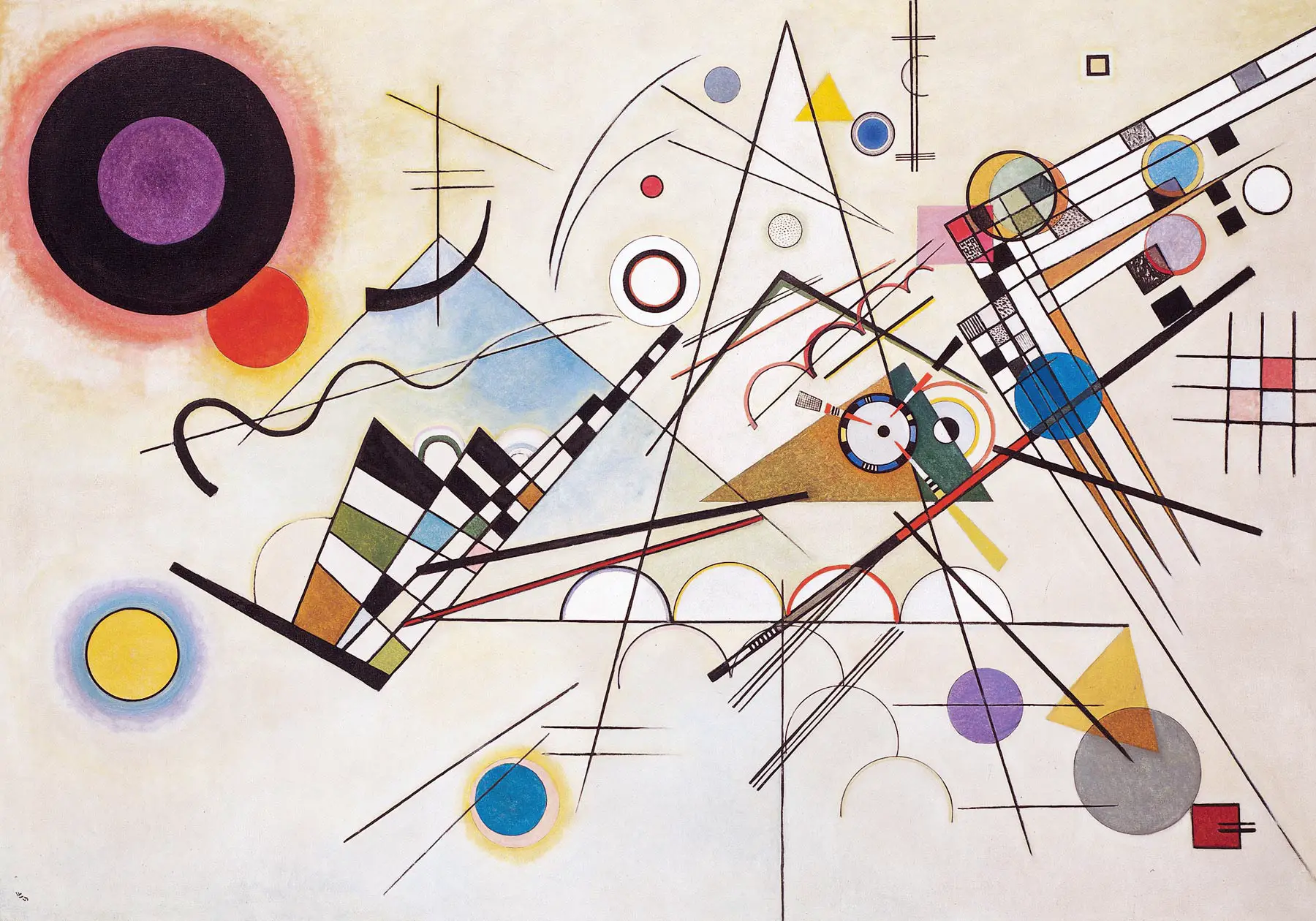
Kyle, Matthew and Nina, the discussion after the presentation made me think of Kandinsky's paintings because he developed some theories about the relations between sound, colors and shapes. You mentioned that you always needed someone to draw in order to interact, maybe this website can help when there is no one to draw and also feed your conversations on how to interpret lines, shapes and colors sonically.

http://www.wassilykandinsky.net/compositions.php


Anand, Harrison and Utku, your work-in-progress made me think of this Radiohead song, Fitter Happier, which uses spoken voice  (although it's Microsoft Sam) as the main element of the piece. In this case the voice doesn't become unintelligible through effects, and the instruments/sounds used are different from the ones you've shown, so it might be interesting to have this as a reference to contrast with what you've experimented so far.


Rachel, Griffin and Ayal, your work-in-progress has this particular organic vibe which made me think of this song/video by Bjork, just consider the first 2 minutes. It also connects in other aspects, like the use of costumes with particular colors and objects that enhance the representation of nature (in this case tectonic plates).